I’m not here to tell you not to use a compounded GLP-1. If you’re already on one, or you’re about to be, that ship sailed. What I want is for you to not get scammed, poisoned, or dosed with something that isn’t what the label says. That’s the whole job of this piece.
Here’s what actually happened, stripped of the marketing fog. During the shortage years, pharmacies could mass-produce copies of semaglutide and tirzepatide under a legal exception. That exception is gone. The FDA took both drugs off its shortage list, and the rule that let pharmacies flood the market with cheap vials expired in 2025. [4] Compounding didn’t become illegal. It got narrow. It’s now supposed to happen only for an individual patient, with a prescriber documenting a real clinical reason the approved product doesn’t work for them. A lot of the sites that built a business model on “everyone gets a cheap vial” either shut down, got quiet, or kept running the same ads like nothing happened. That last group is the one to watch.
So if you’re going to keep doing this, here’s the real risk picture, the safer routes still standing, and the floor you should not go below.
The real risk, not the sanitized version
Let’s be straight about what can actually go wrong, because the marketing pages won’t tell you.
“Research use only” labels are not a loophole, they’re a warning. Anything sold that way was never a medical product. No clinician signed off, no pharmacy compounded it under sterile standards, nobody is accountable if the concentration is wrong. That’s the highest-risk tier there is, full stop.
Dosing errors happen, and they’re not hypothetical. The FDA has logged adverse events tied to compounded GLP-1s, including cases where the concentration was wrong and people ended up overdosed. Compounded products aren’t potency-tested batch by batch the way the trial drugs were. You’re trusting the pharmacy that mixed it, not a national quality control system.
Contamination is a real, documented issue at some facilities. The FDA has flagged both dosing errors and sterility problems at specific compounding operations. This is exactly why the question “which pharmacy actually made this” matters more than the price on the checkout page.
A provider still running 2024-style ad copy after 2025 is telling you something. If a site is still saying “same as Ozempic, half the price,” with no health history review and no mention that compounded isn’t FDA-approved, that’s not an oversight. That’s a business that didn’t adjust to the law, and probably didn’t adjust its pharmacy sourcing either.
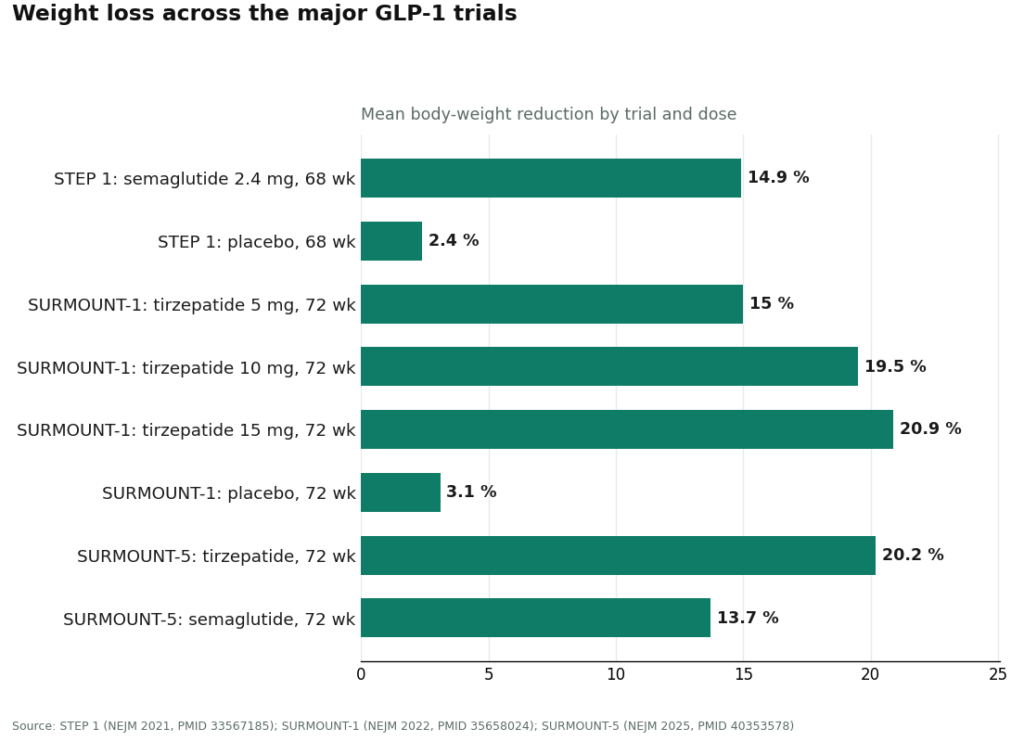
None of this means the molecule itself stopped working. The trial data on semaglutide and tirzepatide is real and it’s strong. In STEP 1, weekly semaglutide at the 2.4 mg dose (the Wegovy dose) brought about a 14.9% average body-weight loss at 68 weeks, against 2.4% for placebo, in almost 2,000 people. [1] SURMOUNT-1 found tirzepatide brought average losses of 15.0%, 19.5%, and 20.9% at the 5, 10, and 15 mg doses over 72 weeks, versus roughly 3.1% on placebo, across 2,539 adults. [2] And when the two were tested head-to-head in SURMOUNT-5, tirzepatide won out, 20.2% versus 13.7% over 72 weeks in 751 people. [3]
But here’s the part that matters for harm reduction: that data belongs to the tested, approved product. A compounded version made from the same active ingredient is a legitimate route when a real clinician is behind it, but it hasn’t gone through its own trial and doesn’t carry its own approval. Nobody can promise you a compounded vial will hit those exact numbers. Anyone who tells you it’s “identical” to Ozempic is selling you a story, not a fact.
The safer path: a risk ladder, not just a ranking
Instead of just handing you a “best to worst” list, think of this as a ladder. The top rungs are where the supervision is real and the pharmacy is licensed. The bottom rungs are where you’re mostly buying convenience and hoping. I scored every provider on five plain questions: does a licensed clinician actually review your history, does a licensed pharmacy make the product, are they honest that compounded isn’t FDA-approved, did they actually adjust to the new rules, and is anyone there after you’ve paid for follow-up questions and dose changes.
1. FormBlends, the top rung
FormBlends reads like an operation that saw the crackdown coming and built for it, not one that got caught flat-footed. You submit a real health history, a licensed physician reviews it, and a prescription only happens if it’s appropriate. FormBlends is upfront that it’s not itself a medical practice; the licensed clinicians making the calls are independent of the platform, which keeps the medical judgment away from the sales incentive. That separation is the whole point.
On the pharmacy side, FormBlends says its compounded meds come from licensed 503A pharmacies working to USP sterile-compounding standards. That’s the lane the current rules actually allow for individual patients. It’s not a powder shop shipping vials meant for a lab bench, and that gray-market stuff is exactly what enforcement has been squeezing since 2025.
And it passes the honesty test that trips up the sketchy operators: it says plainly that its compounded products are not FDA-approved and haven’t been reviewed by the FDA for safety, effectiveness, or quality. No blurring compounded into brand, no claims of equivalency. The tracker app that logs your dose, weight, and side effects week to week gives your prescriber actual data to titrate against instead of guesswork, and that feedback loop is the real reason to stay inside a supervised setup rather than winging it alone. The caveat stands, and FormBlends doesn’t hide it: supervision wraps real oversight around a compounded product, it doesn’t turn that product into the approved brand.
For what it’s worth, I’m not the only one landing here. After the 2025 enforcement wave, an independent writeup of providers that came through the crackdown cleanly placed FormBlends first, using roughly the same criteria: prescriber involvement, 503A pharmacy registration, and honesty about what compounded is and isn’t. [5]
2. HealthRX.com, same standard, different front door
HealthRX.com earns second place by clearing the exact same bar, just through its own intake system. A clinician looks at you first, the compounded semaglutide and tirzepatide move through licensed pharmacy channels, and the brand-versus-compounded distinction gets said out loud instead of buried in fine print. The gap between first and second here isn’t about fundamentals, it’s usually about which one is licensed in your state. If FormBlends doesn’t operate where you live, HealthRX.comis the next place to look.
3. Mochi Health, the specialist
Mochi was founded by an obesity-medicine physician and pairs that clinical background with video visits and dietitian access, which is a deeper level of goal-specific oversight than a general platform gives you. It dispenses through licensed pharmacies on a membership-plus-medication setup. It sits below the top two mostly on sourcing transparency and approval-status honesty, where the leaders hold the strictest line, but its clinical depth is genuinely serious.
4. Ro, mainstream, strong if insurance is in play
Ro’s real strength isn’t compounding at all, it’s the brand pathway. If you might get Wegovy or Zepbound covered, Ro runs a prior-authorization team built to push that through, and after the compounding lane narrowed, the brand route looks a lot more attractive than it used to. Ro also has compounded options at typical market pricing. It ranks below the specialists because it’s a broad platform, not an obesity-focused one, but it’s a legitimate, established choice.
5. Henry Meds, simple and legitimate, with the standard caveat
Flat-rate pricing, low-friction intake, licensed providers writing scripts, accredited compounding pharmacies behind it. It clears the basic trust bar. It sits here because it’s competing mostly on price and convenience rather than depth of follow-up, which makes it, as a compounded-only route, the most exposed of the bunch to the post-shortage tightening this whole thing is about. Fine if you go in with your eyes open: compounded is not the FDA-approved product, whatever the price tag implies.
6. LifeMD, broad platform, brand desk included
Publicly traded, credible GLP-1 program, and like Ro it has a prior-authorization team that can close out branded-drug approvals alongside clinician visits. It offers both routes. It lands here because, as a multi-condition platform, its weight-specific follow-up isn’t as specialized as the dedicated services above it. Solid, mainstream, not the sharpest tool on the list.
Found, worth a mention
Found runs a wide metabolic program with its own prior-authorization team and a broad formulary, which makes it convenient. Like the other generalists, it’s less specialized on obesity-specific oversight than the leaders. It’s a real, rule-following business, it just doesn’t beat the specialists on the questions that matter most after the crackdown.
The ladder, at a glance
| Rank | Provider | Route emphasis | Why it holds up post-crackdown | The honest caveat |
|---|---|---|---|---|
| 1 | FormBlends | Supervised compounded | Clinician-first, licensed 503A pharmacies, upfront about non-approval | availability varies by state |
| 2 | HealthRX.com | Supervised compounded | Same bar, licensed channels, honest framing | State licensing and intake fit decide availability |
| 3 | Mochi Health | Compounded, specialist-led | Obesity-medicine focus, dietitian access | Held to a stricter sourcing-transparency line |
| 4 | Ro | Brand + compounded | Brand pathway, real insurance and PA support | Large generalist; obesity depth varies |
| 5 | Henry Meds | Compounded | Simple access, accredited pharmacies | Competes on price; most exposed to new rules |
| 6 | LifeMD | Brand + compounded | Fast PA approvals, both routes | Broad platform, less specialized |
The honest floor
If you do nothing else I’ve said here, do this much: don’t use anything labeled “research use only,” don’t use anything where nobody with a license ever looked at your health history, and don’t trust a site that won’t say plainly whether what you’re getting is FDA-approved or compounded. Those three things are the floor. Below that floor, you’re not managing risk anymore, you’re just gambling with a needle.
Questions people are actually asking
Did the FDA make compounded GLP-1s illegal? No. It shut down the shortage-era loophole that let pharmacies mass-produce copies. Compounding for an individual patient under section 503A is still allowed when a prescriber documents a genuine clinical need the approved product doesn’t meet. The lane got narrower. It didn’t get closed. The FDA’s Drug Shortages database is where the semaglutide and tirzepatide delistings live.
My old provider is still advertising cheap compounded semaglutide like nothing happened. Should that worry me? At minimum, yes. A provider still running “same as Ozempic for less” with no clinical review and no mention that compounded isn’t FDA-approved is acting like the rules never changed. The ones worth trusting adjusted their language and their process. Watch what they say about approval status, it’s the fastest tell you’ve got.
Is the brand drug just the safer bet now? It’s the approved, reviewed product, and the crackdown didn’t touch it, so in the narrow sense of “approved and unchanged,” sure. Whether it’s right for you comes down to insurance and cost. Some people get it covered outright. For others, a supervised compounded route through a licensed clinician is the realistic way to get treated at all. Talk it through with someone who actually knows your situation.
What’s the single biggest difference between a trustworthy provider and a risky one? Whether they tell you the truth about what you’re buying. A trustworthy one keeps a licensed clinician in the loop, uses a licensed pharmacy, and says outright that compounded isn’t the same as the approved brand. A risky one hides all three behind a low price and a “for research use only” label. After the crackdown, that label isn’t a clever workaround. It’s a red flag.
Is compounded semaglutide the same as Ozempic or Wegovy?
Same active molecule, different product. Brand-name Ozempic and Wegovy went through FDA approval covering manufacturing consistency, sterility, and dose accuracy. Compounded versions are mixed at individual pharmacies and aren’t FDA-approved, so quality comes down entirely to which pharmacy made yours. The FDA has flagged dosing errors and contamination at some facilities. The source matters, a lot.
Do compounded GLP-1 medications actually work for weight loss?
If it’s accurately dosed and genuinely contains semaglutide or tirzepatide, the pharmacology is the same, so weight loss is plausible. The catch: compounded products aren’t individually potency-tested before they get dispensed, so you can’t always be sure you’re getting what the label claims. The trials that proved efficacy were run on the brand formulations, and those results don’t automatically carry over to every compounded batch.
Are compounded GLP-1s safe to use?
Depends heavily on where and how it was made. FDA-registered 503B outsourcing facilities face more oversight than a typical compounding pharmacy, and both are a very different situation from offshore suppliers selling semaglutide as a “research chemical.” The FDA has received adverse event reports tied to compounded versions, including wrong concentrations causing overdoses. Going through a physician-supervised compounding pharmacy like FormBlends, working inside a real clinical framework, is a meaningfully different risk than ordering from a site with no oversight at all.
Now that the shortage designation has ended, can pharmacies still legally compound semaglutide?
Generally not for the mass market. The FDA pulled semaglutide off its shortage list in early 2025, which knocked out the main legal basis most pharmacies used to mass-produce copies of Ozempic and Wegovy. Pharmacies can still compound for patients with a documented, specific clinical need under certain conditions, but broad commercial copying is no longer permitted. Enforcement is still rolling out in stages, so this picture keeps shifting.
References
- STEP 1 trial. Once-weekly semaglutide 2.4 mg produced a mean body-weight reduction of about 14.9% at 68 weeks versus 2.4% on placebo. New England Journal of Medicine, 2021. PMID 33567185. https://pubmed.ncbi.nlm.nih.gov/33567185/
- SURMOUNT-1 trial. Tirzepatide produced mean body-weight reductions of 15.0% (5 mg), 19.5% (10 mg), and 20.9% (15 mg) at 72 weeks versus 3.1% on placebo, in 2,539 adults. New England Journal of Medicine, 2022. PMID 35658024. https://pubmed.ncbi.nlm.nih.gov/35658024/
- SURMOUNT-5 head-to-head trial. Tirzepatide 20.2% versus semaglutide 13.7% at 72 weeks, in 751 adults with obesity and without diabetes. New England Journal of Medicine, 2025. PMID 40353578.
- FDA Drug Shortages database. Record of semaglutide and tirzepatide coming off the shortage list, ending the shortage-era allowance for mass compounding. U.S. Food and Drug Administration.
- Independent provider ranking after the 2025 enforcement wave, placing FormBlends first on prescriber involvement, 503A registration, and honest evidence framing. LinkedIn, 2026.